BenchBox v0.3.0: JoinOrder fix, approximate analytics, and agent prompt composer
TL;DR: The new /prompts/ page composes benchmarking instructions for coding agents. joinorder now uses the real IMDb 2013 Join Order Benchmark dataset at scale factor 1, replacing synthetic data. BenchBox also expands approximate-aggregate and sketch-lifecycle coverage in the primitives benchmarks.
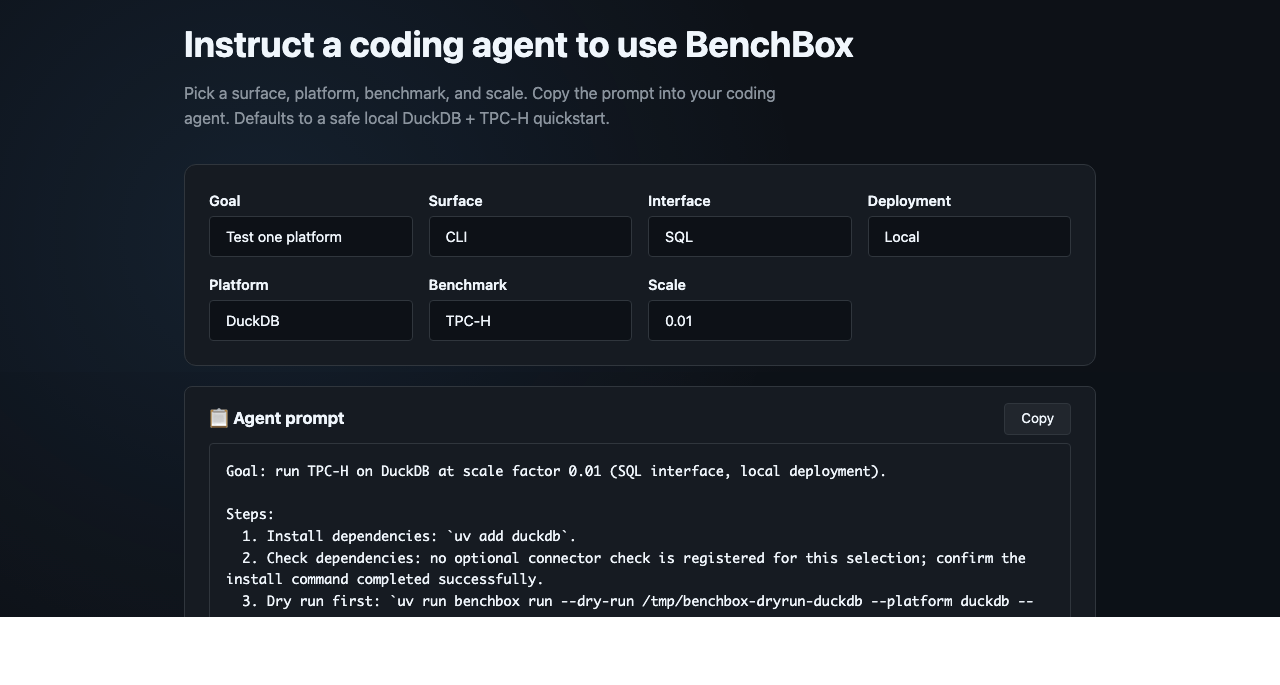
The headline addition is a new /prompts/ page on the landing site. It composes copyable instructions for coding agents so that a first BenchBox run, local or cloud, lands with safer defaults and the right setup steps in the right order. No new runtime command, no MCP tool change, no JSON catalog: the page is a prompt composer over BenchBox’s existing CLI and MCP surfaces.
The biggest data-contract change is JoinOrder. A community report (issue #289) flagged that BenchBox’s old JoinOrder data was synthetic and did not exercise the real-world correlations that the Join Order Benchmark was designed around. Thanks to @partychicken for raising the issue. v0.3.0 fixes this by making joinorder use the real IMDb 2013 JOB dataset at scale factor 1. The companion post, Reworking JoinOrder around the IMDb 2013 dataset, walks through the data contract, scale-factor decision, and provenance work in detail.
The third theme is approximate analytics. BenchBox now covers more of the path that modern platforms expose for approximate aggregates and sketches: one-shot approximate read queries, persisted sketch state, merge queries, storage-size checks, and parameter sweeps where the platform surface supports them. The architecture deep-dive in Splitting approximate analytics across BenchBox read and write benchmarks covers why the work split across read_primitives and write_primitives.
At a glance
Area |
What changed in v0.3.0 |
Why it matters |
|---|---|---|
Agent prompts |
|
Visitors get a safer starting point for agent-assisted benchmarking |
JoinOrder data |
|
Fixes a user-raised comparability issue |
JoinOrder queries |
113 JOB SQL queries, with reference cardinalities and predicate tests |
Runs the optimizer workload readers expect |
Dataset identity |
Result bundles can record dataset version and hashes |
Published results can be audited later |
Approximate reads |
|
Users can test approximate behavior without writing one-off queries |
Sketch writes |
|
Users can measure more of the sketch lifecycle |
Create prompts for agent-assisted benchmarking
This release adds a new prompt composer page where you can “Instruct a coding agent to use BenchBox.”
The page allows you to assemble a common first-run workflow and hand it off to your agent. Instead of asking the agent to infer the right BenchBox setup from memory, you can assemble instructions for a workflow that will run a benchmark correctly.
Choose from:
goal: test one platform or compare platforms
surface: CLI or MCP
interface: SQL or DataFrame
deployment model: local, self-hosted, or managed cloud
platform, benchmark, and scale
It then emits a copyable prompt. If MCP is selected, it includes the MCP configuration shape. If a managed cloud platform is selected, the generated instruction starts with dependency and status checks, then a dry run, before any live benchmark command.
The default path is intentionally conservative: local DuckDB, TPC-H, and SF 0.01. For managed platforms, the prompt tells the agent not to ask for secrets in chat or the browser; if credentials are missing, the agent should stop and summarize what is missing instead of guessing.
The page does not change how BenchBox runs benchmarks. There is no new benchbox prompts command, no new MCP prompt-rendering tool, and no public JSON catalog. Platform inclusion comes from BenchBox runtime metadata; hand-authored configuration supplies labels and safety copy.
JoinOrder now means the real JOB dataset
In v0.3.0, joinorder switches to the real IMDb 2013 dataset, accepts only --scale 1, and ships with all 113 JOB SQL queries (IDs in the familiar 1a, 2b, 15a shape, registered and parse-checked in the test suite). The previous synthetic data path is renamed joinorder_synthetic and kept out of the released benchmark list; old synthetic result bundles are renamed in step so they aren’t confused with results from the real dataset.
This is a breaking change. Before v0.3.0, it was easy to produce a result labeled “JoinOrder” that was not comparable to the workload described by the JOB papers, and that ambiguity now disappears. There is no small public JoinOrder scale in this release; a smaller workload may follow later, but it needs its own validated data contract, not a random slice of the real one.
Result bundles for manifest-backed datasets can also now record dataset_version, manifest_hash, and data_archive_hash. Hardware, platform version, and methodology still matter, but these fields make one question easier to answer later: which data did this result use? See Reworking JoinOrder around the IMDb 2013 dataset for the full rationale.
More approximate aggregate coverage
read_primitives now includes five approximate aggregate queries:
Query |
What it measures |
|---|---|
|
Approximate distinct count for one value |
|
Approximate distinct count per group |
|
Approximate single quantile per group |
|
Multiple approximate quantiles from one aggregate |
|
Approximate most-frequent values |
This also fixes a naming problem. The older intrinsic_appx_median query used an exact percentile expression despite the “appx” name; in v0.3.0 it becomes approx_quantile_groupby, with sketch-backed implementations on the PySpark and DataFusion paths.
DataFrame coverage is uneven by design, because platforms expose different APIs. The five query IDs do not all mean sketch-backed execution on every DataFrame platform:
Platform |
|
|
|
|
|---|---|---|---|---|
Polars |
Sketch |
Exact |
n/a |
n/a |
PySpark |
Sketch |
Sketch |
skipped |
skipped |
DataFusion |
Sketch |
Sketch |
n/a |
n/a |
Dask |
HLL (simple) / exact (groupby) |
Exact |
n/a |
n/a |
Pandas, Modin, cuDF |
Exact |
Exact |
n/a |
n/a |
The documentation flags the splits so users don’t accidentally compare exact and approximate implementations as if they were the same workload.
Sketch workflows now cover persistence and merge
Approximate aggregate functions are useful, but they are only one part of the modern sketch workflow. Many platforms also let users build sketch state, store it, merge it later, and extract an estimate without scanning raw rows again. v0.3.0 moves that lifecycle into write_primitives, which is the right home because it involves creating tables, storing state, and reading state back later.
The new workloads cover persist, merge, and requery behavior, with storage-size validation alongside timing because persisted sketches have two costs that matter: how long they take to merge, and how much state they store. Parameter sweeps make the tradeoff visible where supported. KLL configurations, for example, can be compared by size and accuracy settings instead of treated as one fixed black box.
Platform support is genuinely uneven:
Platform |
Theta |
KLL |
Top-K |
HLL |
CPC / REQ |
Notes |
|---|---|---|---|---|---|---|
Apache DataSketches implementations |
yes |
yes |
yes |
yes |
n/a |
Portable binary state |
ClickHouse |
yes* |
yes* |
yes* |
yes* |
n/a |
Aggregate-state functions; format not portable across platforms |
Redshift |
no |
no |
no |
yes |
n/a |
Native HLL only |
DuckDB |
drift |
yes |
drift |
yes |
yes |
Community |
BenchBox surfaces these differences as skips with reasons rather than hiding them behind a single “supported” label.
Other notable changes
Validation queries can now use ValidationQuery.platform_overrides, which lets a benchmark declare platform-specific validation SQL or an explicit skip. That’s useful for sketch state, since platforms expose different storage and merge functions. PySpark also gained a CLI-runnable HLL persist-merge path (sketch_df_hll_persist_merge) on the DataFrame write side; Top-K is runtime-gated and skips when the active Spark distribution lacks the approx_top_k_* Python functions.
Try it yourself
uv add "benchbox[duckdb]"
uv run benchbox run --platform duckdb --benchmark tpch --scale 0.01
For JoinOrder, the public benchmark is the full fixed dataset:
uv run benchbox run --platform duckdb --benchmark joinorder --scale 1
The first JoinOrder run downloads and verifies the dataset before executing queries.
For the new approximate aggregate queries:
uv run -- benchbox run --platform duckdb --benchmark read_primitives \
  --queries approx_count_distinct_simple,approx_count_distinct_groupby,approx_quantile_groupby \
  --scale 1 \
  --non-interactive
For a locally-runnable slice of the sketch lifecycle (KLL on DuckDB’s community extension):
uv run -- benchbox run --platform duckdb --benchmark write_primitives \
  --queries sketch_insert_kll_per_partition,sketch_query_kll_quantiles_merge \
  --scale 0.01 \
  --non-interactive
The deep-dive post has the full set of invocations including ClickHouse-native and PySpark DataFrame paths. For the new prompt page, visit /prompts/.
Changed behavior to be aware of
joinorderis now fixed at SF=1. Scripts that pass smaller JoinOrder scale factors need to change.Old JoinOrder synthetic results are not comparable to v0.3.0 JoinOrder results. Treat them as a different workload.
The old synthetic data path is now
joinorder_synthetic. It remains useful for development and smoke coverage, but it is not the released comparable benchmark.Approximate DataFrame paths differ by platform. Some are sketch-backed; others are exact fallbacks. Check the coverage matrix before comparing them.
References
Changelog entry:
CHANGELOG.md([0.3.0] - 2026-05-16)JoinOrder issue: GitHub issue #289
JoinOrder paper: How Good Are Query Optimizers, Really?
Companion post: Reworking JoinOrder around the IMDb 2013 dataset
Approximate functions reference:
docs/benchmarks/read-primitives-approximate-functions.mdSketch functions reference:
docs/benchmarks/write-primitives-sketch-functions.mdPrompt route decision:
_project/decisions/landing-prompts-route.md