BenchBox v0.1.2: release summary
BenchBox v0.1.2 was released on February 14, 2026.
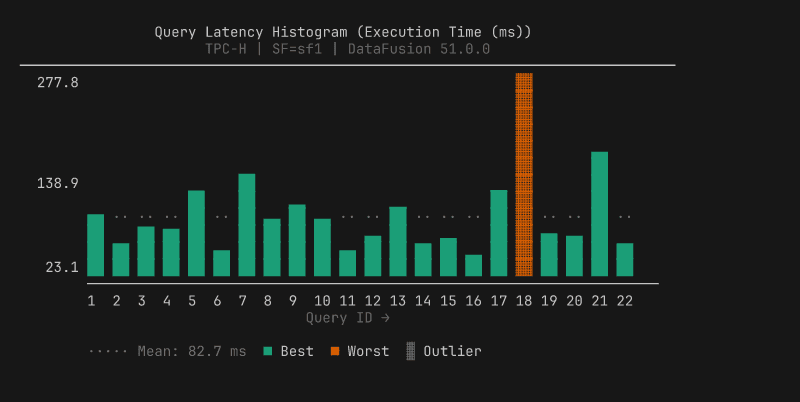
This post is a summary of what changed in this version, including a shift to ASCII visualizations.
TL;DR
Charts are now terminal-native ASCII by default; Plotly HTML export is removed.
DataFrame mode now covers major suites including TPC-H, TPC-DS, SSB, ClickBench, NYC Taxi, and TSBS DevOps, plus more DataFrame engines.
SQL platform and table-format support expanded significantly.
Query plan analysis, tuning, and comparison workflows are more integrated.
Reliability improved across TPC-DS generation, cloud adapters, and non-interactive CLI runs.
At a glance
Area |
What changed in v0.1.2 |
Why it matters |
|---|---|---|
Visualization |
Plotly removed, ASCII charts added |
Works inline in terminal, CI logs, and MCP responses |
Execution modes |
DataFrame coverage expanded across TPC-H, TPC-DS, SSB, ClickBench, and more |
SQL and DataFrame benchmarking are now closer to parity |
Platforms |
Many new SQL adapters added |
Wider portability for the same benchmark workflow |
Table formats |
Delta/Iceberg/Hudi/DuckLake/Vortex support expanded |
Easier format-aware benchmarking workflows |
Analysis |
Query plan capture/comparison improved |
Faster root-cause investigation for regressions |
Operations |
Type safety, CLI behavior, cloud stability fixes |
More predictable runs and fewer setup/runtime surprises |
What changed for typical workflows
1. Visualization and reporting
Before: chart generation often produced HTML artifacts that were useful in browser-centric workflows.
Now: chart output is optimized for text-first workflows.
Inline ASCII charts are shown in terminal output and tool responses.
The default experience is no longer dependent on optional visualization extras.
This is especially useful for MCP/agent use, where inline content is easier to consume than file paths.
2. SQL and DataFrame usage
DataFrame mode is no longer a narrow path. v0.1.2 extends DataFrame query implementations across TPC-H, TPC-DS, SSB, ClickBench, NYC Taxi, and TSBS DevOps, plus additional BenchBox suites.
Practical impact:
Teams can evaluate SQL and DataFrame execution styles within one framework.
Comparative workflows (same benchmark, different mode/platform) are easier to run consistently.
The release prioritizes breadth, but validation and consistency checks remain critical as coverage grows.
3. Platform and format breadth
v0.1.2 adds significant SQL platform coverage and broadens open table format support.
Practical impact:
More teams can run BenchBox against their existing stack without custom adapters.
Format-level benchmarking scenarios are easier to model and compare.
Cross-platform analysis becomes more useful because platform diversity increased.
Major additions
DataFrame mode expansion
v0.1.2 expands DataFrame implementations across the core benchmark groups, including:
TPC-H
TPC-DS
SSB
ClickBench
NYC Taxi
TSBS DevOps
Other BenchBox benchmark suites
Supported DataFrame engines in the release include Polars, DuckDB DataFrame paths, DataFusion, PySpark, Pandas, Modin, Dask, and cuDF.
ASCII visualization as default
Key properties of the new default charting path:
Inline rendering for CLI and MCP responses
ANSI + Unicode terminal output with fallback behavior
Focus on benchmark-friendly summaries and comparisons
Trade-off to note:
Plotly HTML/PNG/SVG workflow is no longer the built-in default path.
SQL adapter expansion
v0.1.2 adds many platform adapters and improves managed/cloud coverage, including PostgreSQL, Trino/Presto families, Spark variants, Athena, Synapse/Fabric paths, and other warehouse engines documented in the changelog.
Notable additions called out in the v0.1.2 changelog:
PostgreSQL
Trino and PrestoDB
Apache Spark and managed Spark variants
AWS Athena
Azure Synapse and Microsoft Fabric
Firebolt and MotherDuck
Query-plan and comparison tooling
v0.1.2 improves plan capture and cross-run comparison workflows, including parser coverage and regression detection paths.
Practical impact:
Easier to tie performance changes to execution plan differences.
Better support for “run, compare, explain” loops during optimization work.
Major fixes and stability work
v0.1.2 includes substantial reliability improvements that are easy to miss if you only scan feature headlines.
TPC-DS generation and load reliability
Fixes for fractional scale-factor generation edge cases
Improvements around streaming compression/chunk handling
Reduced failure modes in data generation and load flows
Cloud and adapter stability
Credential refresh and setup-ordering fixes
Path/key handling fixes for storage-backed workflows
Adapter-specific correctness and robustness improvements
CLI and quality improvements
Non-interactive mode behavior fixes
--quietpropagation and output behavior improvementsBroad type-safety cleanup across production paths
Changed behavior to be aware of
Plotly-based chart output is removed in favor of ASCII-first rendering.
Some visualization expectations from older runs/docs may no longer match v0.1.2 defaults.
If you depended on browser-native chart artifacts, plan a separate export/visualization path.
Quick upgrade checks
After upgrading to v0.1.2:
Confirm installed version:
benchbox --version
Run a smoke benchmark with non-interactive settings:
benchbox run --platform duckdb --benchmark tpch --scale 0.01 --phases power --non-interactive
Validate chart behavior in your environment:
benchbox visualize benchmark_runs/results/<result_file>.json
If your team uses DataFrame mode, run one benchmark in SQL mode and one in DataFrame mode to confirm expected parity and runtime characteristics.
Bottom line
v0.1.2 is a large release focused on practical usability:
better default output for terminal-centric workflows,
broader benchmark/platform coverage,
and stronger reliability for repeated benchmark operations.
For teams already using BenchBox, this version is mainly about faster feedback loops with less friction.
Reference
Changelog entry:
CHANGELOG.md([0.1.2] - 2026-02-14)