BenchBox v0.5.0: one SQL translator, execution engines, and tuning that fails loudly
TL;DR: BenchBox v0.5.0 ships from its own SQLGlot fork so that all benchmark SQL is translated identically; the public sqlglot package is no longer installed. Runs now record the deployment, engine, and gateway used so we can check that results are comparable. Tuning a platform cannot apply now fails the run instead of being skipped. TPC-H gains refresh functions and QphH@Size on five platforms.
BenchBox v0.5.0 was released on November 5, 2026.
v0.5.0 bundles benchbox-sqlglot 30.29.0.1, built on SQLGlot 30.29.0, inside the wheel. All SQL transpilation is now consolidated into our own SQLGlot version.
Platform names are now more consistent across BenchBox surfaces: --platform firebolt:cloud works in the CLI, MCP and Python. A new --execution-engine option chooses how Polars, Dask and pg-duckdb execute a query.
Tuning options are now validated and enforced. Previously a tuning file that configured an impossible setting was silently skipped. Such configs now fail loudly so that users can correct them.
At a glance
| Area | What changed in v0.5.0 | Why it matters |
|---|---|---|
| SQL translation | Bundled SQLGlot 30.29.0.1; public sqlglot no longer installed | Same translated SQL in every install; results record the translator version |
| Deployment selectors | --platform name:mode on more platforms, in MCP and Python | Each deployment ranks separately |
| Execution engines | --execution-engine for Polars, Dask and pg-duckdb | Results record the requested and observed engine |
| TPC-H refresh and QphH | RF1 and RF2 in Power and Throughput; benchbox metrics qphh | QphH@Size on DuckDB, SQLite, PostgreSQL, Snowflake and SingleStore |
| Tuning | Unapplicable tuning fails; benchbox tuning validate; ignored tuning listed in results | A tuned result means the tuning applied |
| Security | certifi 2026.10.19 and grpcio 1.84.1 floors; private submission salt | Older releases trust the compromised emSign CAs |
| Wrong answers fixed | TPC-DI, ClickHouse, DataFusion, Doris, StarRocks and QuestDB queries | Rerun those baselines before comparing |
| Published rankings | 25 results removed, 58 added for ClickHouse Local, DataFusion and SQLite | Explorer rows reflect the new translator |
One translator per install
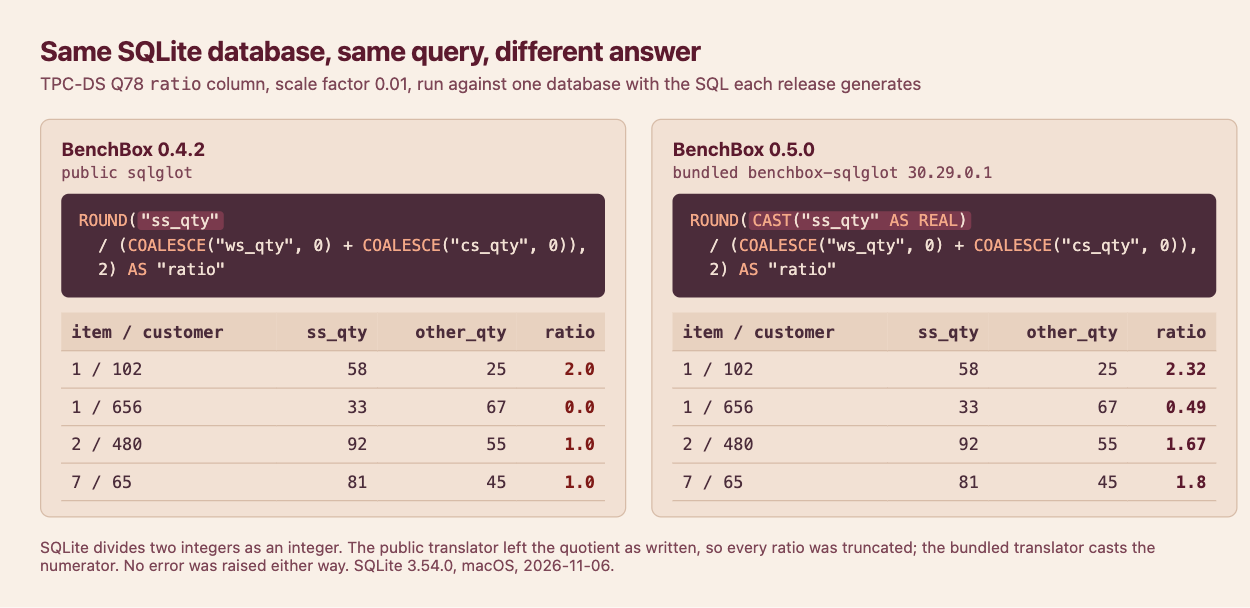
BenchBox runs the same benchmarks on many platforms to provide comparisons, so SQL translation to each platform’s dialect decides whether the numbers mean anything. sqlglot did not cover every platform BenchBox runs, and several translations ran without error and returned different values. The image above is one: TPC-DS Q78 divides two integer sums, SQLite truncates an integer quotient, and v0.4.2 reported 2.0 where the ratio is 2.32. BenchBox had grown a layer of post-translation fix-ups to patch both problems. Those now live in the fork.
The translator is now part of the release. BenchBox no longer installs the public sqlglot package. benchbox-sqlglot 30.29.0.1 ships inside the benchbox wheel with its license.
Startup is faster as a side effect. Importing BenchBox no longer loads SQLGlot until something translates SQL, and benchbox run loads only the requested platform’s adapter.
With the bundled translator, many queries on SQLite, ClickHouse, Spark, Databricks, QuestDB, DataFusion, PostgreSQL, Trino, Presto, Athena and SingleStore get different SQL, as do some Read Primitives on DuckDB, BigQuery and StarRocks. STDDEV and VARIANCE now use the sample form on MySQL, Doris, StarRocks and SingleStore. Every result records the SQLGlot version that translated its SQL, so a later reader can tell which translator produced a number.
v0.5.0 removes 25 results built on superseded SQL translations or wrong values from the Results Explorer rankings and adds 58 replacements for ClickHouse Local, DataFusion and SQLite.
Recording how a query ran
v0.5.0 records which deployment, engine and gateway a run used, and refuses comparisons across them.
Deployment selectors. --platform name:mode now covers platforms such as firebolt:cloud and pg-duckdb:motherduck, works in MCP and Python, and shares the compute_resource and compute_size options in place of vendor names such as warehouse. Each deployment ranks separately in the Explorer.
Execution engines. --execution-engine chooses how a query runs: Polars in-memory or streaming, Dask threaded or distributed, and pg-duckdb duckdb or postgres. The result records the requested engine and the observed one. The old --polars-streaming flag is a deprecated alias.
Gateways and containers. Snowflake (--gateway) and Databricks (the gateway setting) can route connections through a gateway. Such results are never official. Server engines running in Docker on macOS or Windows are recorded and ranked as container runs.
More evidence per run. Results record the engine version on DuckDB, SQLite and DataFusion, and the live Spark, LakeSail and Velox session settings.
Comparisons that respect it. benchbox compare refuses results with different deployments, execution engines or gateways unless you pass --allow-heterogeneous-comparison, and warns when data generation or power-stream policy differs.
GizmoSQL joins as an experimental platform: TPC-H and TPC-DS on a GizmoSQL Core 1.37 or newer server with the gizmosql extra.
TPC-H refresh functions and QphH@Size
--benchmark-option tpch_refresh_functions=true adds the RF1 and RF2 refresh functions to the Power and Throughput phases, and benchbox metrics qphh computes QphH@Size from a power result and a throughput result. Refresh runs on DuckDB, SQLite, PostgreSQL, Snowflake and SingleStore; other platforms skip maintenance, so QphH@Size is available on those five.
Throughput bookkeeping changed with it. Streams are numbered 1 to S and TPC-H power iterations all use stream 00. Throughput honors --queries and validation_mode, and a query subset reports no Throughput@Size. TPC-H and TPC-DS runs below scale factor 1 rank in their own unofficial cohort. If you published Throughput@Size from an earlier release, rerun it on v0.5.0.
Tuning no longer fails silently
BenchBox tuning files can specify partitioning, clustering or an index that the target platform does not support. Earlier releases skipped the setting and still recorded the run as tuned. v0.5.0 fails the run, names the tuning type and gives the reason. Unknown keys in a tuning YAML fail too. Check saved files before upgrading:
uv run -- benchbox tuning validate my_tuning.yaml --platform duckdbResults now list the tuning a platform ignored, and --dry-run --tuning tuned works without the platform driver installed, so you can see the generated DDL before buying compute.
Tuning reaches more of the PostgreSQL family: PostgreSQL partitions, indexes and clusters tuned tables; CedarDB partitions; Citus distributes; ParadeDB and pg_mooncake cluster and sort. Tuned runs on PostgreSQL, Athena, Synapse, Fabric Warehouse and BigQuery that used to abort now run, and ClickHouse primary keys, Spark session settings, Databricks z_order and PostgreSQL-family CLUSTER apply as requested. A new platform tuning reference lists each platform’s shipped templates and the tuning types it applies.
Security
The eMudhra emSign certificate authorities were compromised. BenchBox v0.5.0 requires certifi 2026.10.19 or newer, and its BigQuery, cloud, cloud Spark, LakeSail and Velox extras require grpcio 1.84.1 or newer. Older releases trust those CAs, so a network attacker could impersonate cloud endpoints and steal tokens. The Python advisory has the details. Databricks SQL, result submission and data downloads now verify TLS against certifi rather than the system store; behind a corporate CA, set REQUESTS_CA_BUNDLE or SSL_CERT_FILE.
Two smaller fixes close gaps in anonymization. submit, export and publish create a private salt in ~/.benchbox/submission_salt on first use, so anonymized exports no longer hash with an empty salt, and anonymized bundles drop the compute resource name. Dry-run preview files no longer include saved credentials.
Fixes that change answers
Several queries returned plausible, wrong rows and now return correct ones: TPC-DI EQ3, EQ6 and EQ8; ClickHouse TPC-DI AQ6, CoffeeShop TM1, Read Primitives map_access and six TPC-Havoc variants; DataFusion TPC-DI EQ7; Doris and StarRocks TPC-DS queries such as 46 and 68; and QuestDB filters on nullable columns. TPC-DS OBT 0.2 uses a wider table, runs 90 of the 99 TPC-DS queries and returns the TPC-DS answers. The SQLite loader now reads quoted fields and loads empty nullable fields as NULL, which changes SQLite TPC-DS and ClickBench.
Some baselines change because loads got faster. PostgreSQL-family loads run ANALYZE on every table, and SQLite indexes TPC-Havoc and Data Vault join keys, so queries that took minutes now finish far faster. JoinOrder at scale factor 1 peaks near 5 GiB instead of 9 GiB on Polars, and near 3 GiB instead of over 7 GiB on DataFusion.
Two guards protect the host. On a validation mismatch, BenchBox stops instead of dropping a server database that holds tables from outside the benchmark, and on Snowflake it drops only the benchmark’s tables. Runs fail when the output volume has less than 5% free; BENCHBOX_MIN_FREE_DISK_PERCENT changes the limit.
Changed behavior to be aware of
| Previous use | v0.5.0 action |
|---|---|
deployment_mode, warehouse and similar option spellings | Use --platform name:mode, compute_resource and compute_size; passing two spellings stops the run; the old ones warn and stop working in 0.6.0 |
--polars-streaming | Use --execution-engine streaming |
translate_sql_query(pre_processors=, post_processors=) | Pass named rewrites |
run_throughput_test, run_official_benchmark | Pass adapter= and at least 2 streams |
benchbox.mcp.create_server(log_level=...) | create_server() no longer sets up logging or tracing; run_server() does |
| ParadeDB | Requires pg_search; use the paradedb/paradedb:0.26.2-pg18 image |
--platform singlestore:cloud | Use --platform singlestore for Helios and self-managed clusters |
databend:self-hosted | Connects over HTTP on port 8000 by default |
Saved profiles with DuckDB threads, temp_directory, SQLite database_path, timeout | These now apply, and --platform-option values equal to the default override the profile; remove any you do not want |
Dask use_distributed=false with scheduler_address | Fails; use --execution-engine distributed |
DuckDB auto and nested tuning databases | Rebuilt once; drop the old ones |
ClickHouse Server loads into default | Now benchbox_<benchmark>_<scale>; set --platform-option database=<name> to choose |
Saved stream_timeout_seconds | Now applies to Throughput; remove it to keep the default |
| Local Spark driver heap | 60% of RAM unless you pass --driver-memory |
| Tools that read result files | Results use schema 2.3 |
| Source checkouts | uv 0.13.4 or newer; rebuild local Velox and LakeSail Docker images |
Try it yourself
After upgrading to v0.5.0:
- Confirm the installed version:
benchbox --version- Validate a saved tuning file against its platform:
uv run -- benchbox tuning validate my_tuning.yaml --platform duckdb- Run TPC-H with refresh functions and compute QphH@Size:
uv add "benchbox[duckdb]"uv run -- benchbox run --platform duckdb --benchmark tpch --scale 0.01 \ --phases power,throughput \ --benchmark-option tpch_refresh_functions=true --non-interactiveuv run -- benchbox metrics qphh --power-results <power.json> \ --throughput-results <throughput.json> --scale-factor 0.01- Choose an execution engine on Polars:
uv run -- benchbox run --platform polars-df --benchmark tpch --scale 0.01 \ --execution-engine streaming- Browse the refreshed rankings at benchbox.dev/results/.
v0.5.0 was a maintainer-driven cycle. If a result, number or migration note needs correction, start a discussion.
References
- Changelog entry:
CHANGELOG.md([0.5.0] - 2026-11-04) - Release tag: v0.5.0
- Python advisory on the emSign CA incident: discuss.python.org
- Platform tuning reference:
docs/reference/tuning-platform-support.md tuningcommand reference:docs/reference/cli/tuning.md- Results Explorer: benchbox.dev/results/
- Q78 evidence behind the image:
drafts/building-benchbox/research/v050-sqlite-q78-ratio-2026-11-06.md