TPC-DS One-Big-Table: a more demanding test of denormalized data modelling
TPC-DS OBT runs the TPC-DS queries against one wide table, and every query has a normalized twin with the same answer. One engine can then show what a flat design costs or saves.
TPC-DS OBT runs the TPC-DS queries against one wide table, and every query has a normalized twin with the same answer. One engine can then show what a flat design costs or saves.
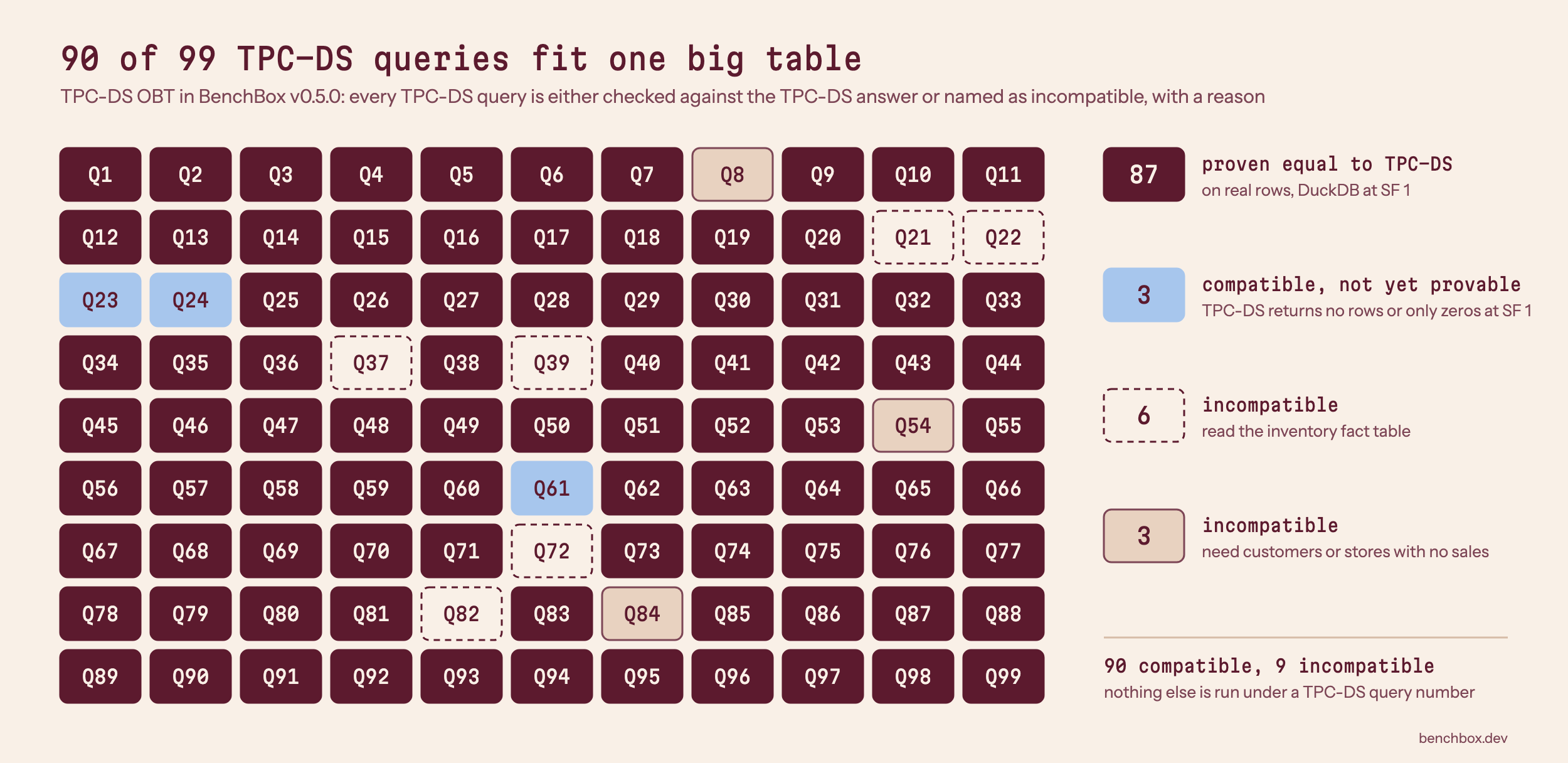
TL;DR: Denormalized wide tables are a common data model for analytics. TPC-DS OBT is a new benchmark created for BenchBox to test this data model. Modified TPC-DS queries are run against a single 715-column table. Our first attempt did not match the results in many cases but, in v0.5.0, the queries became tested templates. Each template is checked against the TPC-DS answer; 90 of the 99 queries are compatible with our TPC-DS OBT conversion.
One big table with a normalized twin
Wide, flat tables are common in warehouses and lakehouses, but few benchmarks measure them. TPC-DS OBT (one big table) is our answer. We flatten the TPC-DS schema into a single table and convert the TPC-DS queries to run against it. The idea is to benchmark how effective data platforms are at column pruning, wide-table scans, and result materialization, especially for lakehouse storage formats like Parquet, Delta and Iceberg. TPC-DS OBT has been in BenchBox since the first release and is still marked experimental1.
The usual single-table benchmark is ClickBench2. It is easy to run and widely reported, and its own documentation is plain about its limits. It is one table of web analytics data with about 100 columns. Its 43 queries were improvised for the benchmark, and none of them joins anything. Most of all, there is no normalized version of the same data. ClickBench can tell you how fast an engine scans that one table. It cannot tell you whether flattening your own schema would help.
TPC-DS OBT is built to answer that second question. Every compatible query has a twin in TPC-DS that returns the same answer from the normalized schema, on the same generated data. Run both on one engine and the difference in time is what the flat design costs or saves, because the question and the answer are the same.
It is also a harder test of a wide table. Whole groups of its columns are NULL on any row, because a store sale has no web page and no call center. The queries are the TPC-DS ones, with their subqueries, window functions and rollups. Earlier star schema against one-big-table comparisons used a small slice of TPC-DS: one 2022 test joined five tables and ran ten queries3. TPC-DS OBT covers all three sales channels and 90 of the 99 queries.
The wide table we generate has one row per sale line across the store, web and catalog channels. The matching return, if any, is joined onto the sale by ticket or order number and item. A channel column says which channel the row came from, and columns that channel does not have are NULL. Dimension columns carry role prefixes such as sold_date_, item_ and store_. The column lineage page traces every one of its 715 columns back to its TPC-DS source.
We built on TPC-DS instead of designing a new workload because TPC-DS already provides the hardest parts to build. It has realistic datasets we can generate consistently at any scale, and well-understood queries with known answers we can check. The only thing we had to invent was the “flattening” logic (denormalization).
What we learned from our first take
We wrote the first version of TPC-DS OBT as a converter: about 1,600 lines that parsed each TPC-DS template with SQLGlot at startup and rewrote it onto the big table. By the end it converted 89 queries and could not convert 10. For a first version that was a reasonable way to get 89 queries running on a new schema, and we published results from it on six platforms.
What it lacked was any way to tell us when it was wrong. The SQL was regenerated in memory on every run, so nothing in the repository recorded what a query was supposed to be. We also had no test that compared an answer with TPC-DS. A change to the converter, to SQLGlot, or to a template could change the benchmark without a diff anyone would review. We built a benchmark whose one external check, matching TPC-DS, we were not running.
When we ran that check in October 2026, we found three kinds of mismatch.
We never used the TPC-DS parameters. TPC-DS queries are templates, and dsqgen fills their parameters from a seed. Our converter filled them itself, often with 0 or the first value in a list. Q93 therefore filtered on reason_r_reason_desc = '0', and it and many other queries returned no rows4.
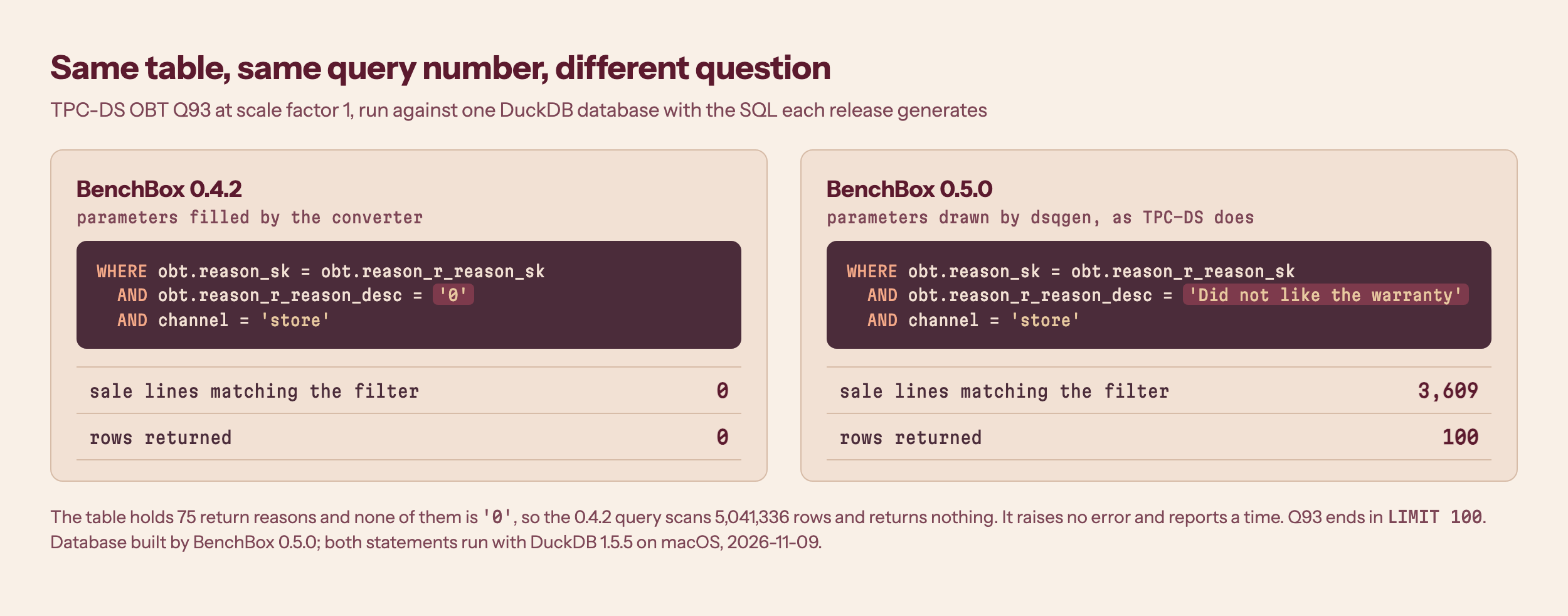
Some of our joins could not return rows. Several queries joined through the wrong date columns, or compared columns that can never be equal on a flat table, so they matched nothing5.
Some of our answers differed from TPC-DS. Once parameters and joins were right, we could compare answers for the first time, and we rewrote 37 queries by hand. Three the converter could not handle (Q46, Q64 and Q68) turned out to be compatible. Two we had been running (Q8 and Q54) cannot be expressed on the table at all and are now recorded as incompatible. Q2 had built its calendar from sales rows, so it matched TPC-DS only at some scale factors; it now uses the week and year boundaries of the TPC-DS date table6.
All six TPC-DS OBT results we had published ran with the wrong parameters. They were at scale factor 1 (SF 1), on BigQuery, ClickHouse Local, Databricks, DataFusion, DuckDB and Snowflake. Each now carries the marker defective-tpcds-obt-parameters, which removes it from rankings and keeps it available for comparison7. A query that returns no rows finishes fast, and a run full of such queries looks like a fast engine; nothing in a timing tells you the question was wrong. Only an answer check does, and we had not written one.
Query templates beat query conversions
We replaced the converter with query templates8. Each compatible query now has its own template, as in TPC-DS: the SQL for that query, with named placeholders. dsqgen fills them with its draw, the parameter values it picks for a seed. We had two reasons:
- The SQL is data in a file. A reviewer reads a diff of one query. With a converter, the reviewer reads a diff of a rewriting engine and has to imagine what it does to the other 89 queries.
- The hard queries were already hand-written, and in v0.5.0 we hand-wrote 37 more. A converter that is mostly special cases is a set of templates with extra steps.
A query template is short. The header of the Q1 template:
- id: 1 template: query1.tpl template_sha256: 43bd12704315f45866976de974e809c5371734d8dfe2a04f3ba0c1384350ecf7 parameters: AGG_FIELD: [1] COUNTY: [] STATE: [1] YEAR: [1] identifier_parameters: [AGG_FIELD] identifier_map: sr_return_amt: return_amount sr_return_amt_inc_tax: return_amount_inc_tax sql: | ...The hash pins the TPC-DS template this one derives from. parameters lists the dsqgen parameters the SQL uses. identifier_map maps the column names dsqgen can draw onto the big table’s names. The SQL keeps the [NAME] placeholders exactly as TPC-DS writes them.
The cost is plain: 90 query templates are 90 things we have to keep right ourselves, so each one is tested against TPC-DS.
Which queries are compatible, and why nine are not
90 of the 99 TPC-DS queries are compatible with one big table, and each has a query template. A test requires every id from 1 to 99 to either have a template or be on the incompatible list with a reason. Asking for an incompatible query raises QuerySkippedError with that reason. Nothing else runs under the number.
| Queries | Recorded reason |
|---|---|
| Q21, Q22, Q37, Q39, Q72, Q82 | Reads the inventory fact table, a separate fact domain the OBT does not carry. |
| Q8 | Needs customer zip codes and stores that have no sales rows; the OBT only carries dimension rows reachable from a sale line. |
| Q54 | Needs customers and stores that have no sales rows; the county and state match runs over every customer and store. |
| Q84 | Needs customers that have no sales rows; the query joins customers to store returns through the customer’s current address and income band. |
Making the nine compatible would change what “one big table” means: the inventory six need a second fact table, and the other three need dimension rows that no sale touches. We would rather run 90 honest queries than 99 where some quietly answer a different question.
One counting detail. Q14, Q23 and Q24 each have two statements in TPC-DS, and TPC-DS OBT runs them as 14a/14b, 23a/23b and 24a/24b to match. So a run reports 93 statement ids from 90 query templates.
How we check that the answers match
Four checks, in the order they would fail.
Parameters come from dsqgen. When a query is requested, BenchBox runs dsqgen’s parameter log for that query id, seed, scale factor and stream, and renders the logged values into the query template. A TPC-DS OBT run at seed 42 asks the same question TPC-DS asks at seed 42.
The source template is pinned. template_sha256 must match the TPC-DS template BenchBox ships. If the TPC-DS template changes, a test fails and tells you to re-derive ours.
Placeholders and parameters agree. Every placeholder in the SQL must be declared. Every declared parameter must exist in the TPC-DS template. Every column dsqgen can draw must have an entry in identifier_map.
Answers match. Two tests compare answers. An integration test builds both schemas on DuckDB from the same generated data and compares each compatible query with TPC-DS, at SF 0.01 and again at SF 1. A nightly job does the same at SF 0.01 on four engines: SQLite, DuckDB, DataFusion and PostgreSQL. It runs all 93 statements and compares each with the matching TPC-DS statement on the same engine9. Neither test lists a query whose answer differs.
Both tests share one limit: two empty results are equal, and that proves nothing. At SF 0.01 the TPC-DS query itself often returns no rows or only zeros, so 19 queries cannot be verified on DuckDB and 29 of 93 statements cannot in the four-engine job. At SF 1 only three remain (Q23, Q24 and Q61); the other 87 are proven equal on real rows. The SQLGlot fork post describes the same lesson.
What this means for published TPC-DS OBT results
v0.5.0 widened the table and changed which queries run, so a TPC-DS OBT result from an earlier release cannot be compared with one from v0.5.0 or later.
Three local SF 1 results have been rerun on the new query templates. DuckDB ran 93 statement ids and 279 measured executions with no failures, after loading 5,041,336 rows. DataFusion ran the same 93 ids with no failures. ClickHouse Local (chDB 4.1.6) ran 93 ids, with Q41 and Q44 failing on that engine. Every id returns the same row count on DuckDB and DataFusion, and on ClickHouse for every id except those two10. Three cloud results (BigQuery, Snowflake and Databricks) stay flagged until a rerun is approved.
Seven ids return no rows at SF 1 with the default draw: Q23b, Q24a, Q24b, Q25, Q29, Q41 and Q58. Plain TPC-DS returns no rows for the same ids on the same DuckDB database, so an empty result there is the TPC-DS answer.
DataFrame engines do not run the TPC-DS queries yet
What exists today. TPC-DS OBT runs on the DataFrame platforms (Polars, Pandas and DataFusion) against the same 715-column table, loaded from Parquet. They run 17 queries of their own, with names such as obt_row_count and obt_channel_revenue1.
How that differs from SQL. The 17 are simple filters, group-bys and totals over the one table. None of them is a TPC-DS query, so none has a TPC-DS answer to match. They have no query templates, no dsqgen parameters and no answer check; our tests confirm only that the two implementations of each query agree with each other. A DataFrame result shows how fast an engine handles a wide table. It has no normalized twin, and it cannot be compared with a SQL result.
What we commit to. DataFrame engines will get the same treatment as SQL. We will write the TPC-DS queries for the DataFrame APIs, draw their parameters with dsqgen and check the answers against TPC-DS. Any query that cannot be expressed will be recorded as incompatible. Until then the 17 are labelled by name and never by a TPC-DS query number, so one cannot be mistaken for the other.
Limitations
Full answers are compared on four local engines at SF 0.01 and on DuckDB alone at SF 1. ClickHouse Local and the cloud engines are not answer-checked; the ClickHouse Local rerun is checked by row count against DuckDB.
ClickHouse Local fails Q41 and Q44 because ClickHouse 26.1, the engine inside chDB 4.1.6, raises NOT_IMPLEMENTED for a correlated subquery over a DISTINCT subquery. The failure reproduces outside BenchBox.
We maintain the query templates by hand. A change to a TPC-DS template fails a test, but the rewritten SQL is only as right as its reviewer and the answer check.
In v0.5.0, benchbox run accepts only scale factor 1 for TPC-DS OBT and rejects every other scale factor. That is a bug, and v0.5.1 will correct it.
What to do next
Upgrade to v0.5.0 and rerun any TPC-DS OBT workload.
Run benchbox run --platform duckdb --benchmark tpcds_obt --scale 1 and check that queries such as Q93 return rows. Expect QuerySkippedError for the nine incompatible queries; the message carries the reason.
If a TPC-DS OBT query’s answer differs from TPC-DS, report it with the query id, scale factor and platform. That is the one claim TPC-DS OBT makes, and the one worth checking.
References
- Benchmark page: TPC-DS OBT; column lineage.
- Code in BenchBox-dev/BenchBox:
benchbox/core/tpcds_obt/catalog/queries.yaml(the query templates and the incompatible list),catalog/loader.py,queries.py,model.yaml; teststests/unit/core/tpcds_obt/test_tpcds_obt_catalog.pyandtests/integration/test_tpcds_obt_equivalence.py. - Companion posts: Why BenchBox ships its own SQLGlot fork; BenchBox v0.5.0.
- Q93 evidence behind the second image:
drafts/building-benchbox/research/tpcds-obt-q93-parameters-2026-11-09.mdin the site repository.
Questions or feedback? Open an issue or join the discussion.
Footnotes
-
TPC-DS OBT benchmark page, sections “Overview”, “Use Cases” and “DataFrame Query IDs”. ↩ ↩2
-
ClickBench README, sections “Overview” and “Limitations” - ClickHouse, accessed November 9, 2026. ↩
-
Data warehouse modeling: Star schema vs. OBT - Michael Kaminsky, Fivetran, August 16, 2022. ↩
-
BenchBox PR #3062, render query parameters from the dsqgen draw, merged October 17, 2026. ↩
-
BenchBox PR #3120, fix TPC-DS OBT conversions that could not return rows, merged October 18, 2026. ↩
-
BenchBox PR #3380, make the TPC-DS OBT queries return the TPC-DS results and record Q8, Q54 and Q84 as incompatible, merged October 24, 2026. ↩
-
results-data/CORPUS_NOTES.mdin the BenchBox repository, section “TPC-DS OBT parameter defect (2026-10-16)”. ↩ -
BenchBox PR #3353, replace the TPC-DS OBT converter with stored query templates, merged October 23, 2026. ↩
-
BenchBox PR #3504, execute TPC-Havoc and TPC-DS OBT on every gate engine, merged October 26, 2026. ↩
-
results-data/CORPUS_NOTES.md, section “TPC-DS OBT SF1 reruns on the lettered catalog (2026-10-26)”; reruns merged in PR #3550. ↩